
How to Build an Email List
Ask any experienced online business owner what they would do differently if they were starting over, and one answer comes up more consistently than almost any other: they would start building their email list sooner.
It doesn’t matter whether you’re a blogger, an affiliate marketer, a digital product creator, or someone just beginning to build an online presence — your email list is the most valuable asset your business can have.
It is the one audience you truly own, immune to algorithm changes, platform shutdowns, and the shifting attention economies of social media.
The good news is that how to build an email list from scratch requires no significant financial investment.
The tools available today — many of them completely free — make it possible to set up a professional, fully functional email list and start capturing subscribers before you spend a single dollar.
What it does require is the right setup, a compelling reason for people to subscribe, and the consistency to keep showing up for your growing audience.
This guide walks you through every step of that process in plain, practical language.
By the time you finish reading you’ll know exactly what to do, in what order, and with which free tools to make it happen.
Why Your Email List Is Your Most Important Business Asset
Before getting into the how, it’s worth being crystal clear about the why — because understanding the value of what you’re building makes it much easier to prioritise it consistently.
When someone subscribes to your email list they are giving you direct, permission-based access to their inbox.
Not their social media feed — where your content competes with dozens of other creators, friends, and advertisers for a few seconds of scrolling attention.
Their inbox — a private space where they choose what to open and read, and where a trusted sender commands a fundamentally different quality of attention.
Your social media followers are borrowed. The platform owns that relationship and can limit your reach, change the rules, or disappear entirely at any point.
Your email subscribers are yours.
You can export your list, take it to a different platform, and continue that relationship regardless of what happens to any third-party service.
For affiliate marketers specifically, the compounding value of a trusted email list is extraordinary.
A subscriber who has received genuine value from you over months converts on your recommendations at a dramatically higher rate than a cold visitor finding your blog for the first time.
The list you build today becomes the engine of your affiliate income tomorrow.
Step 1: Choose Your Email Marketing Platform
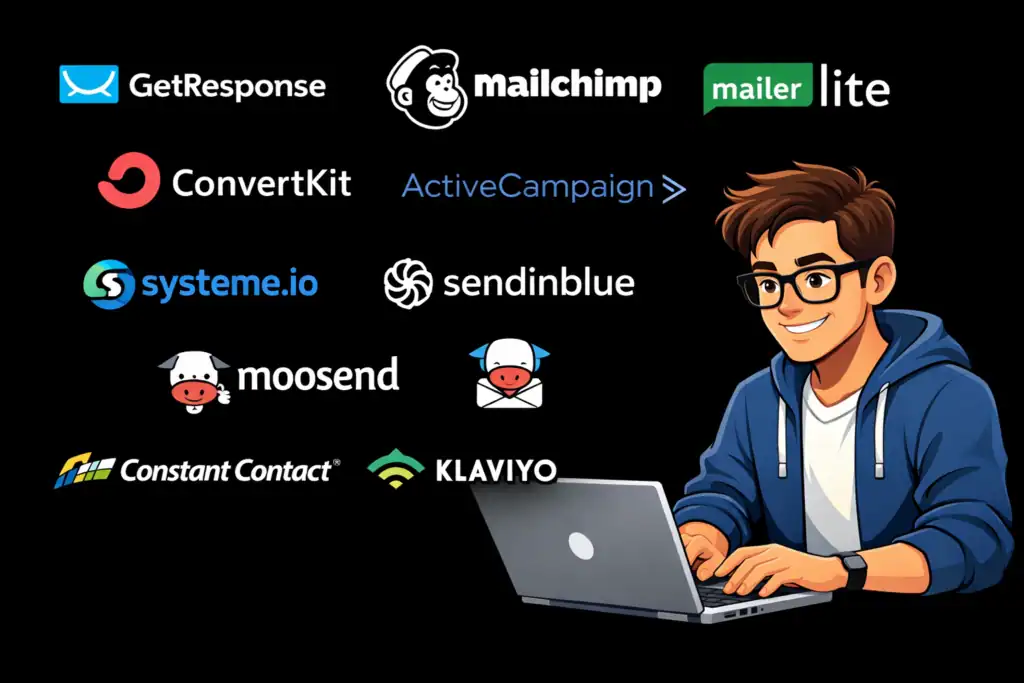
Your email marketing platform is where your subscriber list lives, where you create and send emails, and where you set up the automated sequences that welcome new subscribers and nurture them over time.
Choosing the right one from the start matters because migrating a list later is possible but time-consuming.
For anyone starting with zero budget the platform I use and recommend unreservedly is Systeme.io.
Their free plan is genuinely functional — not a crippled trial with a countdown clock, but a fully operational email marketing system that includes everything you need to build and manage a list of up to 2,000 subscribers.
On Systeme.io’s free plan you get unlimited email sending to your list, automation sequences for welcome emails and follow-up series, opt-in form creation, landing page and funnel building, and integration with your blog or website — all without paying anything.
For a blogger or online business owner just starting their list building journey, there is no better free starting point available.
The platform also means you don’t need separate tools for your email marketing, your opt-in landing pages, and your funnels — everything lives in one dashboard, which eliminates the technical headaches of connecting multiple platforms and reduces the time spent managing your infrastructure rather than building your audience.
🔗 Get started free with Systeme.io ←
Other platforms worth knowing about include Mailchimp, which offers a free plan for up to 500 contacts, and MailerLite, which has a free tier for up to 1,000 subscribers.
Both are solid options, though Systeme.io’s combination of email marketing with funnel and landing page building makes it the more complete free solution for online business owners.
Step 2: Create a Lead Magnet Worth Subscribing For
Here is the reality of list building in 2026: “subscribe to my newsletter for updates” is not a compelling enough reason for most people to hand over their email address.
Your audience is sophisticated, their inbox is already busy, and they need a specific, tangible reason to subscribe.
That reason is your lead magnet — a free resource you offer in exchange for a visitor’s email address.
The right lead magnet does two things simultaneously: it solves a specific problem or delivers specific value to your ideal reader, and it naturally attracts the type of subscriber who will be genuinely interested in your content and recommendations over time.
The most effective lead magnets share common characteristics.
They are specific rather than general — “5 Free Tools to Build Your First Sales Funnel This Week” outperforms “Digital Marketing Resources” because it makes a concrete promise to a defined audience.
They are immediately useful — something the subscriber can implement or benefit from right away rather than something they’ll get around to eventually.
And they are closely aligned with both your niche content and the products or services you eventually recommend, so that the subscribers you attract are genuinely pre-qualified for your affiliate offers.
Lead magnet formats that work well for bloggers and online business owners:
A checklist is the fastest to create and one of the highest-converting formats.
A single-page document that helps your reader accomplish a specific task step by step — like the SEO audit checklist format — is immediately actionable and requires minimal time to produce.
A short PDF guide of five to ten pages covering a specific topic in more depth than a single blog post allows is highly effective for audiences seeking to learn something new.
It positions you as a knowledgeable resource from the first interaction.
A resource list — a curated collection of the best tools, articles, or programs in your niche — works well for audiences who are in research mode.
A “Top 10 Free Tools for Building an Online Business” resource list, for example, naturally integrates affiliate links while delivering genuine value.
A mini email course delivered over three to five days introduces your new subscriber to your email communication style gradually, builds the relationship before any commercial ask, and keeps your name appearing in their inbox consistently during the critical first week of the subscription when engagement is highest.
A template — a swipe file, a content calendar, a spreadsheet, a social media caption template — offers immediate practical utility and tends to attract action-oriented subscribers who are most likely to implement recommendations.
Creating your lead magnet for free:
Canva is the tool of choice for creating visually polished lead magnets without design skills or budget.
Their free plan includes templates for ebooks, guides, checklists, and resource documents that you can customise with your branding and content in minutes.
Export as a PDF and your lead magnet is ready to deliver.
🔗 Create your lead magnet free with Canva
[convertkit_form form=”8842229″]
Step 3: Set Up Your Opt-In Landing Page
Your opt-in landing page is the dedicated page where visitors arrive, learn about your lead magnet, and enter their email address to receive it.
This page has one job — converting visitors into subscribers — and everything on it should serve that single purpose.
In Systeme.io, creating an opt-in landing page is straightforward even without technical skills.
Select a template from their library, customise the headline, the lead magnet description, and the call-to-action button text, connect it to your email list, and your opt-in page is live.
The whole process takes under thirty minutes once your lead magnet is ready.
A high-converting opt-in page has a few consistent elements.
The headline clearly states what the visitor will receive and why it’s valuable — be specific and benefit-focused rather than vague and generic.
A brief description of what the lead magnet contains and what the subscriber will be able to do with it addresses the “is this worth my email address?” question directly.
A single, clear call to action — one button, one form, no competing links or distractions — keeps the visitor focused on the one thing you want them to do.
Keep the page simple.
The temptation to add more information, more context, and more detail is understandable but usually counterproductive.
Visitors to an opt-in page have already expressed enough interest to arrive there — what they need is a clear, frictionless path to claiming what you’re offering, not a long-form sales pitch.
Step 4: Add Opt-In Opportunities Across Your Blog
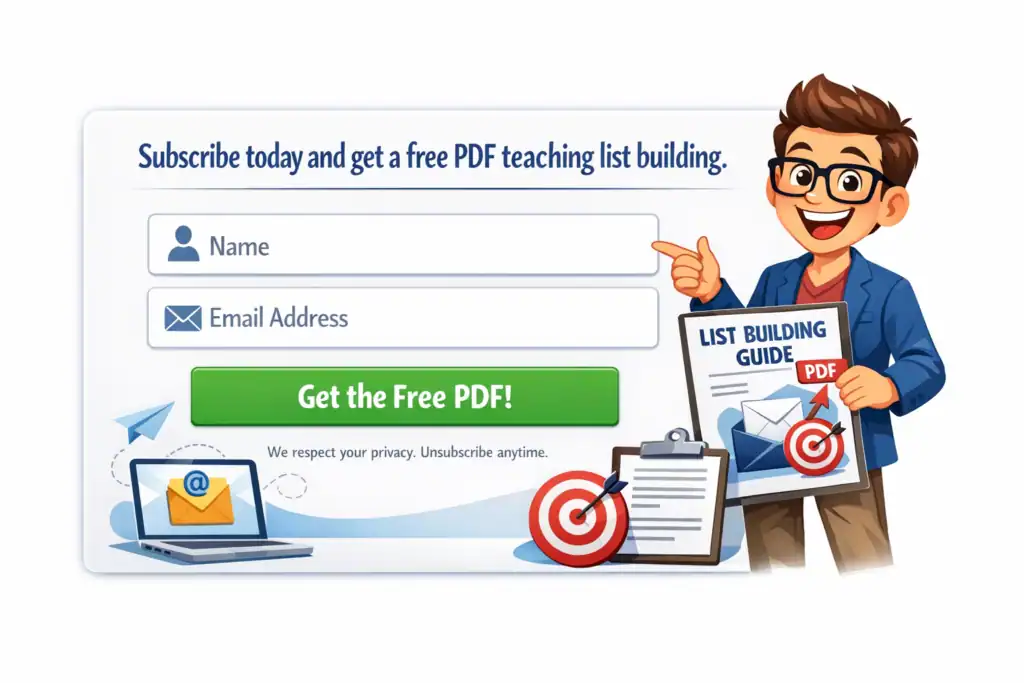
Your dedicated landing page is important but it’s not the only place on your site where visitors should have the opportunity to subscribe.
The more opt-in touchpoints you create, the more of your existing traffic you convert into subscribers.
Within blog post content is one of the most effective placements because it’s contextual — a reader who is actively engaged with your content is in exactly the right mindset to subscribe for more of it.
A natural mention of your lead magnet with an inline opt-in form, placed approximately two-thirds of the way through a post when the reader is most engaged, converts reliably.
At the end of every post is a standard placement that every blog should have.
A short, compelling invitation to subscribe — ideally referencing the specific lead magnet and its value — gives readers who’ve finished your content a natural next step.
In your site’s header or hero section ensures that visitors who arrive on any page of your site are immediately aware of your opt-in offer without having to scroll.
This is particularly valuable for first-time visitors who may not read all the way through a post.
As a pop-up — used thoughtfully rather than aggressively — can significantly increase opt-in rates when triggered at the right moment.
An exit-intent pop-up that appears when a visitor is about to leave your site captures a segment of your audience that would otherwise disappear without subscribing.
Timing-based pop-ups that appear after a visitor has spent thirty to sixty seconds on a page target engaged readers rather than interrupting people the moment they arrive.
In Systeme.io you can create opt-in forms for all of these placements and embed them on your WordPress site using a simple code snippet.
No advanced technical knowledge is required.
Step 5: Write Your Welcome Sequence
The moment someone subscribes to your list is the moment of highest engagement they will likely ever have with your brand.
They’ve just taken an action that signals genuine interest — they want to hear more from you.
What happens in the first few days of that subscription largely determines whether they become a long-term engaged subscriber or someone who opens one email and gradually forgets they subscribed.
A welcome sequence is a series of automated emails — typically three to five — sent to new subscribers over their first week or two.
Setting it up once in Systeme.io means it runs automatically for every new subscriber forever, delivering a consistent, value-building experience without any ongoing effort from you.
A simple, effective welcome sequence structure:
Email one is sent immediately upon subscription and delivers the lead magnet.
Keep this email short and focused — thank them for subscribing, deliver what you promised, and give them a brief preview of what they can expect from your future emails.
First impressions matter and this email sets the tone for everything that follows.
Email two arrives one to two days later and introduces you properly.
Share your story — not an exhaustive biography, but the specific journey that led you to your niche.
Why do you write about what you write about?
What have you learned that your readers will benefit from?
What makes your perspective on this topic worth their attention? Authenticity here is more persuasive than polish.
Email three delivers your best content — a link to your most useful or most popular blog post, a tip or insight that genuinely helps, or a resource your subscriber might not have found on their own.
This email establishes the value pattern subscribers will come to expect from you and begins building the trust that eventually converts to affiliate commissions.
Email four, if you include it, can go deeper into your area of expertise — a more detailed tip, a lesson from your experience, or a piece of content that addresses a common misconception in your niche.
This is the email where your voice and perspective really begin to distinguish you from the sea of generic content your subscriber encounters elsewhere.
Email five can introduce your first soft recommendation — a tool you use, a resource you trust, a program you recommend.
By this point your subscriber has received genuine value from you multiple times before any commercial ask, which is the relationship foundation that makes recommendations land rather than feel like spam.
Step 6: Drive Traffic to Your Opt-In

A perfectly crafted lead magnet and a beautifully designed opt-in page generate zero subscribers without traffic.
Getting people to your opt-in — whether directly to your landing page or through your blog where opt-in forms are embedded — is the ongoing work of list building.
Your existing blog content is the most natural source of opt-in traffic if you’ve embedded forms contextually within posts.
Every new blog post you publish is an opportunity to invite readers to subscribe, and every old post can be updated to include an opt-in invitation if it doesn’t already have one.
Pinterest deserves particular emphasis for list building because it drives intent-matched traffic — people actively searching for topics you write about — at a speed that Google SEO for new sites cannot match.
Create a pin specifically promoting your lead magnet with a compelling image and description, link it directly to your opt-in landing page, and you have a perpetual traffic driver that can send subscribers your way for months from a single pin.
Social media sharing of your lead magnet — posting about it directly, sharing the landing page link, and mentioning it in relevant community discussions — generates early subscribers before your organic search traffic has built to meaningful levels.
Mentioning your lead magnet within your blog posts and email content creates ongoing internal promotion.
Link to your opt-in landing page from within relevant posts, mention it in the content of posts where it’s contextually relevant, and include it in your email signature.
Guest posting on established blogs in your niche, with a mention of your lead magnet in your author bio, exposes your opt-in offer to an existing audience that is already interested in your topic area.
Step 7: Stay Consistent and Keep Showing Up
Building an email list is not a one-time setup task — it is an ongoing relationship with a growing audience that requires consistent attention and genuine value delivery over time.
The most common list-building mistake after the initial setup is neglecting to email regularly.
Subscribers who hear from you consistently develop a relationship with your voice and perspective.
Subscribers who hear from you once every few weeks gradually forget why they subscribed and treat your emails as interruptions rather than welcome arrivals.
Whatever email frequency you decide on — once a week is a solid starting point for most bloggers — treat it as a commitment and honour it.
The second most common mistake is treating your list purely as a promotional vehicle.
Every email that exists only to ask something of your subscriber — click this link, buy this product, sign up for this offer — without delivering anything of independent value erodes the relationship that makes those asks effective.
The rule of thumb that serves most email marketers well is to aim for roughly three to four value-focused emails for every one that contains a promotional ask.
Your list will grow slowly at first.
That is completely normal and not a reason for discouragement.
A list of 200 genuinely engaged subscribers who trust your recommendations is worth more in practical terms than a list of 2,000 passive subscribers who rarely open your emails.
Focus on quality of relationship over quantity of names, and the quantity will follow as your content and your reputation build over time.
Frequently Asked Questions
How do I build an email list with no money?
Start with Systeme.io’s free plan — it includes email marketing, automation sequences, opt-in forms, and landing page creation for up to 2,000 subscribers at no cost.
Create a lead magnet using Canva’s free plan.
Drive traffic to your opt-in through your existing blog content, Pinterest, and social media sharing.
You can build a fully functional list-building system without spending anything.
How many subscribers do I need before email marketing becomes worthwhile?
There is no minimum threshold.
Even a list of 50 engaged, interested subscribers is worth emailing regularly — both for the relationship it builds and for the practice it gives you in communicating with your audience.
The habits and voice you develop with a small list scale directly to a large one.
What is the fastest way to grow an email list?
The fastest organic growth typically comes from a combination of a highly specific, genuinely compelling lead magnet and consistent Pinterest traffic driving people to your opt-in landing page.
Pinterest can generate subscriber traffic within days rather than the months Google SEO typically requires for new content.
Should I use a pop-up on my blog?
Yes — used thoughtfully. An exit-intent pop-up that appears only when a visitor is leaving your site adds subscribers without interrupting the reading experience.
Avoid pop-ups that appear immediately when someone arrives on your site — this is among the fastest ways to increase your bounce rate and frustrate first-time visitors.
What should I send my email list once they subscribe?
Start with a welcome sequence — a series of three to five automated emails that deliver your lead magnet, introduce you authentically, and establish the value pattern subscribers will expect.
After the welcome sequence, send a regular email — weekly is ideal — mixing valuable content, personal insights, and occasional relevant recommendations.
How do I stop people from unsubscribing?
Focus on delivering genuine value consistently and emailing at a predictable, reasonable frequency. Unsubscribes are a natural part of list management — some attrition is healthy and actually improves your list quality by removing people who were never going to engage.
What to avoid is emailing too frequently, sending content that isn’t relevant to what subscribers signed up for, or making every email a promotional ask without delivering independent value.
Can I make money from a small email list?
Yes. List size matters less than list quality and relationship depth.
A small list of highly engaged subscribers who trust your recommendations will generate more affiliate income than a large list of passive, disengaged subscribers.
Focus on the relationship, not the number.
When should I start building my email list?
The answer to this question is always the same regardless of when you ask it: immediately.
Every day your blog or online presence exists without an email opt-in is a day of potential subscribers lost forever.
Start today with a free platform, a simple lead magnet, and a basic opt-in form — and improve it over time as you learn what your audience responds to.
Final Thoughts
Building an email list from scratch with zero budget is not just possible — it is one of the most straightforward and high-leverage activities available to any blogger or online business owner in 2026.
The tools are free, the process is learnable, and the asset you build compounds in value with every subscriber who joins and every email that deepens the relationship.
The bloggers and online entrepreneurs who look back five years from now and wish they had started sooner are the ones who read guides like this one and waited for the perfect moment.
The perfect moment is today. Set up your platform, create your lead magnet, add your opt-in forms, and send your first welcome email.
Your future subscribers are out there right now, searching for exactly what you have to offer. Give them a way to find you and stay connected.
This post contains affiliate links. If you make a purchase through these links I may earn a small commission at no extra cost to you. I only recommend products and services I genuinely use and believe in.