

Keyword Density For Bloggers in 2026
If you’ve ever sat down to write a blog post with an SEO plugin open beside you, you’ve probably experienced the creeping anxiety of watching the keyword density indicator hover in the wrong color .
While you try to figure out how many more times you need to squeeze your focus phrase into a piece of writing that’s starting to sound distinctly robotic.
“Best tools for online business. In this guide to the best tools for online business, we’ll explore the best tools for online business that every online business owner needs.”
Sound familiar?
That is keyword stuffing — the misguided result of taking keyword density advice too literally — and it is one of the most damaging things you can do to both your reader experience and your search rankings.
Hence keyword density for bloggers is a reality that many tend to ignore but is so vitally important.
The good news is that you don’t have to write that way.
The better news is that writing naturally, without obsessing over keyword count, is not just more enjoyable — it is more effective for SEO than the mechanical approach most beginners are taught.
This guide explains exactly why, what keyword density actually means in 2026, and what you should be doing instead of counting keyword repetitions.
What Keyword Density Actually Means

Keyword density refers to the percentage of times a specific word or phrase appears in a piece of content relative to the total word count.
If your post is 1,000 words and your focus keyword appears 10 times, your keyword density is 1%.
For a brief period in the early history of search engine optimization — roughly from the late 1990’s through the mid-2000’s — keyword density was a legitimate ranking signal.
Search engines at that time were relatively unsophisticated and used the frequency of keyword appearances as a primary indicator of what a page was about.
More repetitions of a keyword meant a stronger signal of relevance, so SEO stuffed keywords into their content as aggressively as possible.
Google noticed. Users noticed.
The results were pages that were borderline unreadable, filled with awkward repetitions of phrases that no human writer would naturally produce.
In response Google began penalizing keyword stuffing, first through manual penalties and eventually through algorithmic updates sophisticated enough to identify and demote it automatically.
The problem is that despite these changes happening well over a decade ago, the legacy of keyword density thinking persists in SEO plugins.
Also in outdated guides, and in the advice passed down through communities of bloggers who learned their SEO during the era when it was relevant.
In 2026 the vast majority of keyword density guidance you’ll encounter as a new blogger is either outdated, misunderstood, or both.
How Google Actually Reads Your Content Today
Understanding what Google’s algorithm actually does with your content — as opposed to what it did twenty years ago — is the foundation of modern SEO thinking.
It explains why the keyword density obsession is not just unnecessary but actively counterproductive.
Modern Google uses a technology called semantic search — the ability to understand the meaning and context of content rather than just identifying the literal words present.
When Google’s algorithm reads a blog post, it is not simply counting how many times a specific phrase appears.
It is building a comprehensive understanding of what the post is about, who it is for, and how well it serves the reader’s likely intent in searching for it.
This means that a post about building an email list does not need to repeat the phrase “building an email list” seventeen times to rank for that term.
Google understands that a post containing words and phrases like email subscribers, opt-in forms, lead magnets, list growth, email automation, welcome sequences, and subscriber engagement is comprehensively about the topic of building an email list.
This is so even if the exact three-word phrase appears only a handful of times.
The related terms that signal topic comprehensiveness to Google are called LSI keywords — Latent Semantic Indexing keywords.
They are essentially the vocabulary of your topic — the words and phrases that naturally appear in well-written, comprehensive content about a subject.
Google uses the presence and diversity of this vocabulary to assess whether your content genuinely covers a topic or merely mentions it superficially.
This has profound practical implications.
Writing naturally about your topic — using the varied, authentic language a knowledgeable person would use when discussing the subject — is inherently good SEO.
Forcing an exact keyword phrase in repeatedly is not just unnecessary; it is a signal of lower content quality that modern algorithms are specifically designed to identify and discount.
What RankMath Is Actually Telling You
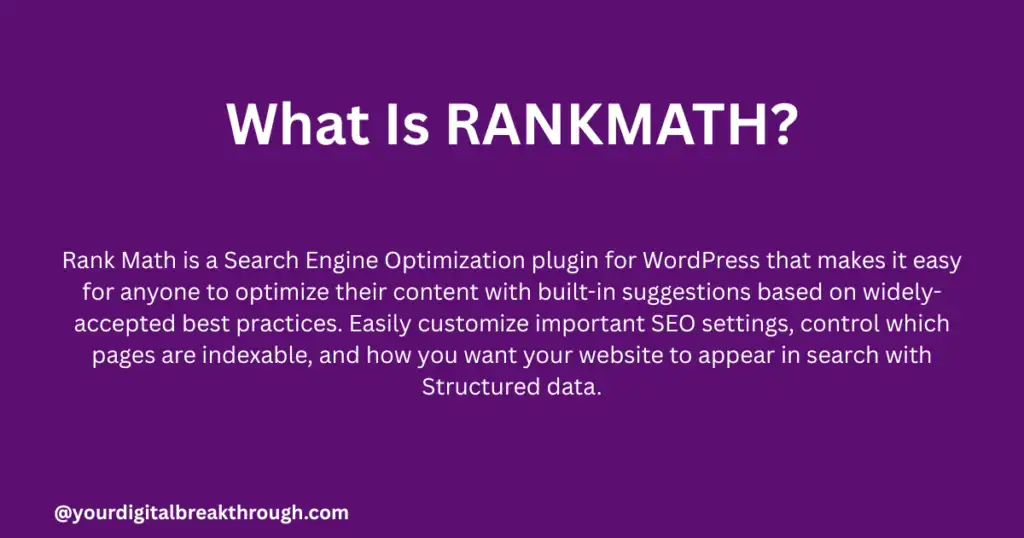
This brings us to the specific frustration that prompted this guide.
The SEO plugin that keeps telling you to use your keyword more may not be actually telling you to do so even if it seems so.
Flashing amber or red when your density isn’t high enough, and creating the anxiety that you’re doing your SEO wrong if you don’t comply isn’t necessarily true..
Here is the important context: RankMath, Yoast, and similar SEO plugins are checklist tools.
They were built to verify the presence of basic optimization signals — is the keyword in the title, is there a meta description, are images using alt text.
They are genuinely useful for these foundational checks. They are prompts to make sure you are on the right track.
The plugin cannot assess whether your content is genuinely helpful.
It cannot evaluate your writing quality, the depth of your coverage, the authenticity of your perspective, or the degree to which your post will actually satisfy a reader’s search intent.
It can only count.
When RankMath suggests you need to use your keyword more frequently, it is not reporting a finding from Google’s algorithm.
It is applying a formula — a percentage threshold — that was developed based on historical SEO practices and has not been meaningfully updated to reflect how search engines actually function today.
Following that suggestion robotically is more likely to harm your content than help it.
The appropriate response to a low keyword density score in RankMath is to check whether your keyword appears in the four genuinely important locations — your title, your first paragraph, at least one subheading, and your meta description — and if it does, to largely ignore the density score and focus on writing naturally.
The Four Places Your Keyword Actually Needs to Appear
While keyword density as a concept is largely obsolete for the body of your content, there are four specific locations where your focus keyword genuinely matters and where its presence has a real, documented impact on how Google understands and ranks your page.
Your post title is the single most important location for your keyword. The title — your H1 heading — is the strongest signal

Google reads to understand what a page is about.
Your focus keyword should appear in your title naturally and in a position that makes the title compelling for human readers, not just keyword-compliant for algorithms.
Your opening paragraph — within the first 100 words ideally — is the second most important placement.
Google pays particular attention to the beginning of your content as an indicator of what the post is about, and early keyword placement confirms to the algorithm that the content delivers on the title’s promise.
At least one subheading — an H2 or H3 within your post — should contain your focus keyword or a very close variation of it.
Subheadings signal content structure to Google and provide additional context about the post’s topic beyond the title alone.

Example of a subheading featuring the focused keyword
Your meta description — the short summary that appears beneath your page title in search results — should contain your focus keyword naturally.
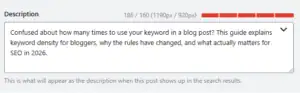
This is what the meta description looks like
While meta descriptions are not a direct ranking factor, they influence click-through rates from search results, and keyword inclusion in the description may cause Google to bold those terms when they match a searcher’s query, increasing visual prominence.
These four placements are the non-negotiable foundations of on-page keyword optimization.
Everything beyond them — including body content keyword density — is secondary and should be driven by natural, reader-focused writing rather than mechanical repetition.
LSI Keywords: The Smarter Alternative to Keyword Stuffing
If mechanical keyword repetition is the wrong approach, what is the right one?
The answer lies in understanding and naturally incorporating the broader vocabulary of your topic — the LSI keywords that signal genuine topical authority to modern search engines.
LSI keywords are not a separate list to research and insert mechanically any more than your focus keyword should be inserted mechanically.
They are simply the natural vocabulary of your subject — the related terms, synonyms, and contextually associated phrases that a knowledgeable person would use when writing comprehensively about a topic.
Consider a post about affiliate marketing for beginners.
The focus keyword might be “affiliate marketing for beginners” — but a genuinely comprehensive post on that topic would naturally contain words and phrases like commission, referral link, niche, content creation, audience, conversion rate, affiliate program, passive income, product recommendation, traffic, and monetization.
Google’s algorithm reads this vocabulary as evidence of genuine topical depth and rewards it accordingly.
You don’t need to research LSI keywords separately or insert them artificially.
Write a thorough, genuinely helpful post that covers your topic comprehensively, and the natural vocabulary of your subject will appear organically throughout your content.
That is precisely what Google is rewarding — and it is precisely what keyword stuffing prevents you from doing.
The Readability Test: Your Most Reliable SEO Check
Beyond keyword placement, the most reliable indicator of whether your content will perform well in search is something no plugin can fully measure: whether a human being would enjoy reading it.
Google’s algorithms have become increasingly effective at measuring user experience signals — how long people stay on your page, whether they return to the search results immediately after arriving on your site, how they interact with your content, whether they share it.
These behavioral signals tell Google whether your content is genuinely satisfying the reader’s intent or merely appearing to match their search query on paper.
Content that reads naturally, flows well, covers its topic thoroughly, and leaves the reader with a clear understanding or actionable takeaway generates better user signals than content that is technically keyword-optimized but stilted and robotic in delivery.
In a very real sense the reader is the ultimate judge of your SEO — and writing for their experience, rather than for a plugin’s score, is the most sustainable SEO strategy available.
A simple test you can apply to any piece of content before publishing: read it aloud.
If any sentence sounds unnatural — if you’d never say it in conversation, if the keyword repetition creates an awkward rhythm, if the phrasing seems constructed for a search engine rather than a person — rewrite it.
That instinct is more reliable than any density score.
A Practical Example: Doing It Right
Let’s make this concrete with a practical example. Suppose your focus keyword is “how to build an email list for free.”
You would place this exact phrase in your title — “How to Build an Email List for Free: A Beginner’s Complete Guide” — in your opening paragraph within the first hundred words, in at least one H2 subheading, and in your meta description.
From that point forward you write naturally.
Your post would organically contain phrases like growing your subscriber base, free email marketing tools, opt-in forms, lead magnets, list building strategies, email subscribers, free plan, capturing leads, and building your audience — all of which signal the same topic to Google through natural, varied language.
By the end of a thorough 2,000-word post your exact focus phrase might appear four or five times total.
Your keyword density might be 0.2% — well below the threshold that makes RankMath happy.
And your post would almost certainly perform better in search than a version stuffed with fifteen repetitions of the exact phrase, because it would be more comprehensive, more readable, and more satisfying for the human reader whose behavior ultimately determines its ranking.
What to Actually Focus on Instead
If keyword density is not the metric worth optimizing for, what should you be paying attention to? Here is where your SEO energy is genuinely well spent.
Search intent alignment is the most important factor in modern on-page SEO.
Does your content actually deliver what someone searching your target keyword is looking for? A post targeting “how to build an email list” should be a practical, actionable guide — not a theoretical overview of why email lists matter.
Matching the format and depth of your content to the intent behind the search is more powerful than any keyword optimization technique.
Content depth and comprehensiveness signal genuine expertise to both readers and search engines.
A post that covers its topic thoroughly — addressing the main question and the related questions a reader would naturally have — outperforms a shallow post that touches the topic without meaningfully addressing it.
Internal linking between related posts on your site distributes authority across your content library and helps Google understand the structure and focus of your site.
Every new post should link to two or three relevant posts already on your site.
Page experience factors including load speed, mobile responsiveness, and clear visual structure affect both user signals and direct ranking considerations.
A technically sound, fast-loading, easily navigable page performs better than an identical page with poor technical fundamentals.
Earning backlinks through genuinely useful, shareable content remains one of the strongest ranking signals available.
No amount of on-page optimization fully compensates for a lack of external sites linking to your content.
Frequently Asked Questions
What is the ideal keyword density for a blog post?
There is no universally ideal keyword density in 2026. Focus on placing your keyword in the four critical locations — title, opening paragraph, one subheading, and meta description — and then writing naturally. A density of 0.5% to 1.5% often occurs organically in well-written posts without any deliberate engineering, which is appropriate.
Should I ignore RankMath’s keyword suggestions completely?
Not completely. RankMath’s checklist items for title optimization, meta description, image alt text, and internal linking are genuinely useful.
Its keyword density suggestion specifically is the one to approach with the most skepticism and override in favour of natural writing when compliance would harm readability.
What are LSI keywords and how do I use them?
LSI keywords are the natural vocabulary of your topic — related terms and phrases that contextually signal what your content is about.
You don’t need to research or insert them deliberately. Write a thorough, genuinely helpful post about your topic and they will appear naturally in your writing.
Will Google penalize me for low keyword density?
No. Google does not penalize low keyword density. It does penalize keyword stuffing — unnaturally high repetition of a keyword phrase.
There is no minimum density requirement, only a ceiling above which content quality degrades.
How do I know if my content is keyword stuffed?
Read it aloud. If the keyword repetition creates an unnatural rhythm or if any sentence sounds constructed for a search engine rather than a human reader, you’ve likely crossed the line.
Trust your ear — natural language sounds natural and forced repetition sounds forced.
Does keyword placement in subheadings really matter?
Yes — subheadings carry more SEO weight than body text and signal content structure to search engines.
Including your focus keyword or a close variation in at least one H2 subheading is one of the genuinely impactful on-page optimization practices worth implementing consistently.
How long should a blog post be for good SEO?
Length should match the depth required to comprehensively address the topic — not a word count target.
For most competitive keywords in the online business space, 1,500 to 2,500 words allows enough depth to cover the topic thoroughly.
Longer is only better if the additional length adds genuine value rather than padding.
What matters more — keyword optimization or content quality?
Content quality, without question. Keyword optimization ensures
Google can understand what your content is about.
Content quality determines whether Google wants to rank it highly. Both matter, but in a hierarchy where quality is primary and optimization is in service of it — not the other way around.
Final Thoughts
The anxiety around keyword density is one of the most common and most counterproductive experiences new bloggers have with SEO, and it stems almost entirely from a misunderstanding of how modern search engines actually work.
Your focus keyword belongs in four specific places — your title, your opening paragraph, at least one subheading, and your meta description.
Beyond those placements, your energy is far better spent writing naturally, covering your topic with genuine depth, and serving your reader with content that satisfies the intent behind their search.
A blog post that a human being genuinely enjoys reading, finds genuinely useful, and shares with someone else who needs it is performing the most powerful SEO action available to you.
No plugin score captures that — but Google’s algorithm increasingly does.
Write for your reader. Trust your voice. Place your keyword where it matters. Then let the content speak for itself.
This post contains affiliate links. If you make a purchase through these links I may earn a small commission at no extra cost to you. I only recommend products and services I genuinely use and believe in.
I do hope you enjoyed this post. as much as I did in writing this article for you.
Let me know your takeaways and do subscribe so you don’t miss any other valuable posts like this one.