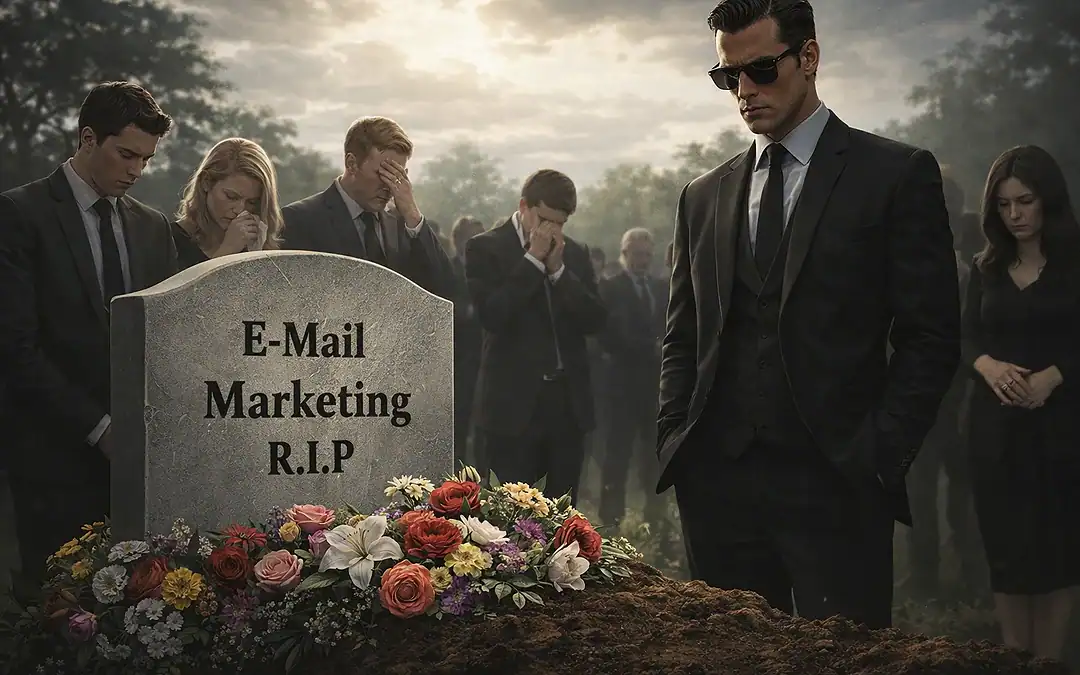
Is Email Marketing Dead In 2026?
Every few years a new wave of voices declares email marketing dead. When social media exploded in the late 2000s, email was supposedly finished.
When push notifications arrived, email was redundant. When messaging apps took over, email was irrelevant.
And now, with AI-generated content flooding every channel and attention spans seemingly shrinking by the day, the question is being asked louder than ever.
So let’s settle it definitively. Is email marketing dead in 2026?
Not only is it not dead — for online business owners, bloggers, and affiliate marketers who understand how to use it properly, email marketing remains the single most powerful communication and conversion tool available.
The data backs this up, the logic supports it, and the experience of virtually every serious online entrepreneur confirms it.
What has changed is the standard required to do it well.
The era of blasting a list with daily promotional emails and watching the commissions roll in is genuinely behind us.
But email marketing done with intention, authenticity, and genuine value for the subscriber is not just alive — it is thriving in ways that no other digital marketing channel can match.
Let’s look at why.
The Numbers That Silence the Debate
Before getting into strategy and philosophy, it’s worth letting the data make the opening argument because the statistics around email marketing are genuinely striking.
Email has approximately 4.3 billion users worldwide as of 2026 — more than any social media platform on earth, and a number that continues to grow year on year.
For every dollar spent on email marketing, the average return on investment sits at around $36 to $42 depending on the industry — a figure that consistently outperforms virtually every other marketing channel including social media advertising, SEO, and content marketing measured in isolation.
Email open rates, while varying by industry and list quality, average between 20 and 40 percent for engaged lists — meaning roughly one in three people who receive your email actually open it.
Compare that to organic social media reach, where platforms like Facebook and Instagram routinely deliver your content to between two and six percent of your followers without paid promotion.
The difference in reach to your own audience is not marginal — it is an order of magnitude.
Perhaps most tellingly, surveys of online consumers consistently show that email is the preferred channel for receiving communications from brands and creators they’ve chosen to follow.
People opt into email lists because they want to hear from those senders.
That consent-based, intentional relationship is something social media’s algorithm-mediated delivery system simply cannot replicate.
The Fundamental Advantage Nobody Talks About Enough
The most important thing about email marketing has nothing to do with open rates, click-through rates, or ROI statistics.
It is this: your email list is the only audience you truly own.
Think about what that means in practice.
Your social media followers exist on platforms you don’t control. Instagram can change its algorithm tomorrow and your reach drops by 80 percent overnight — and there is nothing you can do about it.
Facebook can decide your content violates a policy, however arbitrarily applied, and your page is gone along with years of built audience.
Tik Tok could be banned in your country or simply fall out of favor with your audience demographic.
YouTube can demonetize your channel.
Google can update its algorithm and your blog traffic can halve in a week.
None of these things can happen to your email list.
It lives in your email marketing platform, and if you ever want to move platforms you can export every subscriber and take them with you.
Nobody can take your list away, restrict your access to it, or reduce your ability to reach the people on it.
In an online business landscape increasingly dominated by platform dependency and algorithm uncertainty, that ownership is not just convenient — it is a strategic asset of the highest order.
Every social media follower you have is renting space in someone else’s building.
Every email subscriber you have is a relationship you own outright.
The sooner online business owners internalize that distinction, the sooner their approach to list building becomes appropriately serious.
Why Social Media Cannot Replace Email
The “email is dead” narrative is almost always accompanied by an implicit or explicit suggestion that social media has replaced it.
This comparison reflects a fundamental misunderstanding of what each channel actually does.
Social media is a discovery mechanism. It is how new people find you — through shares, hashtags, recommendations, and platform algorithms surfacing your content to audiences who don’t yet know you exist.
It is excellent at introduction and terrible at depth.
The relationship between a social media follower and a creator is typically shallow and passive — they scroll past your content in a feed alongside dozens of other creators competing for the same few seconds of attention.
Email is a relationship mechanism.
It is how you deepen connections with people who have already discovered you and expressed genuine interest by subscribing.
An email lands in a private inbox — a space where the reader is not simultaneously scrolling past fifteen other creators. It commands a different quality of attention.
It allows for longer, more nuanced communication.
It creates a more intimate dynamic between sender and reader than any public social post can.
The most successful online businesses use both channels in complementary ways — social media to bring new people into their world, email to deepen the relationship with those who raise their hand and say they want more.
Treating them as competitors rather than complements is one of the most common strategic mistakes in digital marketing.
The Real Reason People Think Email Marketing Is Dead
The “email is dead” narrative typically comes from one of two sources, and understanding both helps clarify what’s actually happening.
The first source is marketers who are doing email marketing badly and experiencing genuinely poor results.
If you’re buying email lists rather than building them organically, sending purely promotional content without delivering genuine value, emailing too frequently without respecting your subscribers’ attention, or failing to segment your list so that people receive content relevant to their specific interests — yes, your email marketing will perform poorly.
But that is a failure of execution, not a failure of the channel.
The second source is the social media and content marketing industry, which has a vested interest in directing attention and budget toward newer, shinier channels.
Podcasts, reels, TikToks, and AI-generated content are all genuinely valuable tools — but none of them have displaced email’s fundamental advantage as an owned, consent-based, direct communication channel.
The channel isn’t dead.
The lazy approach to using it is what’s dying, and honestly that’s a good thing for everyone who’s willing to use it properly.
What Effective Email Marketing Looks Like in 2026
If blasting promotional emails to a cold list is what’s dying, what does effective email marketing actually look like in the current environment?
It starts with a reason to subscribe. Nobody gives away their email address for nothing in 2026. The days of “subscribe to my newsletter” as a sufficient call to action are behind us.
You need a lead magnet — a specific, genuinely valuable free resource that your ideal reader actually wants.
This could be a checklist, a short guide, a template, a mini email course, a resource list, or any other format that delivers immediate, tangible value in exchange for the subscription.
The more specific and relevant your lead magnet is to your niche, the higher your opt-in conversion rate will be.
It delivers consistent value before asking for anything.
The subscribers who eventually buy from your affiliate recommendations or purchase your digital products are almost always those who have received genuine value from you through multiple emails before any commercial ask.
A welcome sequence — a series of three to five emails sent automatically to new subscribers over their first week or two — is the most powerful tool for establishing this value relationship from the moment someone joins your list.
It sounds like a human being wrote it.
The emails that get opened, read, and clicked are those that feel personal — written in a genuine voice, sharing real perspectives, occasionally telling stories from your own experience.
Emails that read like corporate newsletters get ignored.
Emails that read like a trusted friend sharing something useful get engaged with.
Your email list is one of the few spaces online where your personality and authenticity are direct competitive advantages.
It respects the subscriber’s attention.
Frequency is one of the most common mistakes email marketers make in both directions — either emailing so rarely that subscribers forget who you are, or emailing so frequently that they feel bombarded and unsubscribe.
For most bloggers and content creators, one to two emails per week is the sweet spot — frequent enough to maintain the relationship, infrequent enough to ensure each email feels like something worth opening.
It uses segmentation thoughtfully.
As your list grows, not every subscriber has the same interests or needs.
Segmenting your list — grouping subscribers based on how they joined, what content they’ve engaged with, or what they’ve told you about themselves — allows you to send more relevant content to each group.
More relevant content generates higher open rates, higher click rates, and higher conversion rates.
It also generates fewer unsubscribes because people stop receiving content that doesn’t match their interests.
Building Your List: The Foundations
If you’re reading this with an existing blog or online business presence but a small or non-existent email list, the most important thing to understand is that there is no better time to start than right now — and no worse approach than waiting until conditions feel perfect.
Every day your blog exists without an email opt-in is a day you’re generating traffic and losing the audience that traffic represents.
Visitors who arrive, read your content, and leave without subscribing are gone — unless they happen to return on their own, which most won’t.
An email opt-in converts that one-time visitor into a relationship you can continue building over time.
Your opt-in should appear in multiple locations on your site — within blog post content where contextually relevant, at the end of posts as a natural next step, in your site’s header or hero section, and as an exit-intent popup for visitors about to leave.
Each placement should clearly communicate what the subscriber will receive and why it’s worth their email address.
For the technical infrastructure of your email list — the platform that stores your subscribers, sends your emails, and manages your automation sequences — the tool I use and recommend without hesitation is Systeme.io.
Their free plan supports up to 2,000 subscribers with unlimited email sending, automation sequences, and opt-in form creation.
For a blogger just getting started with list building, that free tier is genuinely all you need until your list outgrows it.
The upgrade path is affordable and the all-in-one nature of the platform means your email marketing, your funnels, and your opt-in pages all live in the same dashboard.
🔗 Get started free with Systeme.io
Email Marketing and Affiliate Income: A Natural Partnership
For affiliate marketers specifically, email marketing deserves particular attention because the relationship between a trusted email list and affiliate conversions is among the most direct in online business.
Think about the conversion dynamic.
A reader finds your blog post through Google, reads your recommendation of a product or tool, and clicks your affiliate link.
That’s a cold conversion — a stranger acting on the recommendation of someone they’ve just met. Conversion rates in this scenario are real but modest.
Now compare that to a subscriber who has been on your email list for three months.
They’ve received your welcome sequence. They’ve read your weekly emails. They’ve seen you recommend tools that genuinely helped them.
They know your voice, trust your judgment, and feel a relationship with you even if you’ve never interacted directly.
When that person receives an email recommendation from you — or reads a blog post you’ve sent them to — the conversion dynamic is entirely different.
They’re acting on the recommendation of someone they trust, and trust converts at a fundamentally higher rate than novelty.
Building an email list is not just a traffic strategy.
For affiliate marketers it is a conversion strategy — one that compounds in value as your list grows and your relationship with subscribers deepens over time.
Frequently Asked Questions
Is email marketing still effective in 2026?
Yes — email marketing consistently delivers the highest return on investment of any digital marketing channel.
With an average ROI of $36–$42 for every dollar spent, and direct access to an audience you own and control, email remains the most powerful relationship and conversion tool available to online business owners.
How do I grow an email list from scratch?
Start with a compelling lead magnet — a specific, free resource your ideal reader genuinely wants. Place opt-in forms in multiple locations on your site.
Drive traffic to your content through SEO, Pinterest, and social media.
Every visitor is a potential subscriber — make sure the opportunity to subscribe is visible and the reason to do so is compelling.
How often should I email my list?
One to two times per week is the sweet spot for most bloggers and content creators.
Consistency matters more than frequency — a predictable schedule trains your subscribers to expect and look forward to your emails.
Whatever cadence you choose, stick to it.
What should I send to my email list?
A mix of valuable content — tips, insights, personal stories, curated resources — and occasional relevant recommendations.
The ratio that builds the strongest relationships is approximately 80 percent value and 20 percent promotion.
Subscribers who consistently receive genuine value are far more likely to act on your recommendations when you make them.
What is a lead magnet and do I really need one?
A lead magnet is a free resource offered in exchange for a visitor’s email address.
In 2026 it is effectively non-negotiable — “subscribe to my newsletter” alone converts at a fraction of the rate of a specific, compelling free offer.
Your lead magnet should solve a specific problem your ideal reader has or give them something they can use immediately.
What email marketing platform should a beginner use?
Systeme.io is my recommendation for beginners — the free plan is genuinely functional with up to 2,000 subscribers, unlimited email sending, and automation sequences included.
It also integrates your email marketing with your funnels and opt-in pages in a single platform, eliminating the need to connect multiple tools.
Can I do affiliate marketing through email without a blog?
Yes.
An email list can function as a standalone platform for affiliate marketing — particularly when combined with a lead magnet and a strong welcome sequence that establishes your expertise and builds trust before any affiliate recommendations are made.
A blog and email list working together is more powerful, but email alone is a viable affiliate marketing platform.
What is an email welcome sequence?
A welcome sequence is a series of automated emails sent to new subscribers over their first week or two on your list.
It introduces you, delivers on the promise of your lead magnet, establishes the value you’ll consistently provide, and begins building the relationship that eventually leads to high-converting recommendations.
It is the single most important email automation any online business owner can set up.
Final Thoughts
Email marketing is not dead. It has never been dead.
What has changed is the level of intentionality and genuine value required to do it well — and that change is good news for anyone willing to meet that standard.
In a digital landscape increasingly dominated by algorithm uncertainty, platform dependency, and AI-generated noise, the ability to communicate directly with an audience you own — people who chose to hear from you and continue choosing to open your emails — is more strategically valuable than it has ever been.
Build your list. Deliver genuine value. Treat your subscribers like the asset they are.
The inbox, in 2026 and well beyond, remains the most valuable real estate in online business.
This post contains affiliate links. If you make a purchase through these links I may earn a small commission at no extra cost to you. I only recommend products and services I genuinely use and believe in.